
Get an Itraconazole (Sporanox) Prescription Online
Itraconazole is a clinically established oral antifungal with a long track record when used correctly and in the right patient. Our board-certified physicians review your full medical history before prescribing, because Itraconazole has a meaningful interaction profile and an FDA black box warning that requires attention.
- New prescriptions for nail fungus, systemic infections, and other appropriate fungal conditions
- Refills for patients already on a confirmed Itraconazole course
- Dose review included at every consultation
- Available 24 hours a day, 7 days a week, across all U.S. states
Subscription starting from $20/month.
Includes unlimited consultations, prescriptions, and a doctor’s note
Trusted by millions for instant online care
Over 1 million patients
5-star Doctor Ratings
4.8 Rating
20k+ App Reviews
4.6 Rating
1k+ Trustpilot Reviews
Why patients choose Your Doctors Online for Itraconazole
Itraconazole is not a medication to be prescribed without a thorough review. It interacts with a large number of commonly taken drugs, is contraindicated in patients with heart failure, and requires liver monitoring in some cases. Here is what the consultation with our physicians actually involves.
A proper interaction review before every prescription
Itraconazole is one of the most potent inhibitors of CYP3A4, an enzyme responsible for metabolizing a significant portion of commonly prescribed medications. This means the drug interaction list is long and clinically important. Our physicians go through your full medication list at every consultation, not as a formality but because a missed interaction with Itraconazole can have serious consequences. Statins, certain anticoagulants, benzodiazepines, antiarrhythmics, and others all require careful attention before this medication is prescribed.
Doctors who understand long treatment courses
Nail fungus does not resolve in a week. Some systemic infections require months of treatment. Our board-certified physicians understand the clinical trajectory of fungal infections and manage both pulse dosing regimens and continuous courses with the same precision. If something changes mid-course, whether your symptoms, your other medications, or your test results, a follow-up consultation is included in your subscription at no extra charge.
Pharmacy coordination without the wait
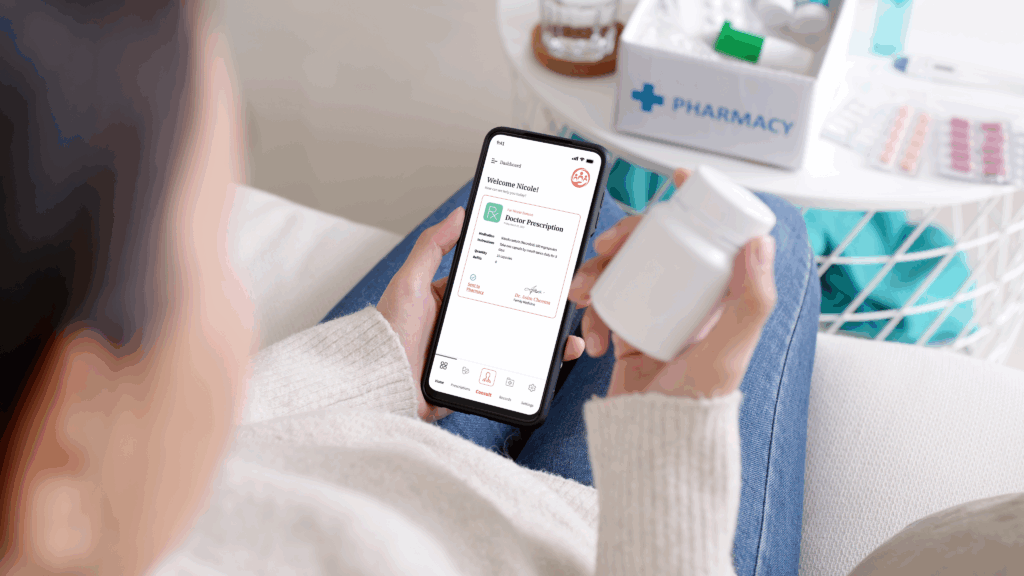
Once your prescription is approved, it is transmitted electronically to the pharmacy you choose. You will see each step confirmed in the app. For a medication that requires consistent daily dosing over weeks or months, having a refill process that does not require a new in-person appointment each time matters.
Subscription plan starts from $20/month
Your subscription includes the consultation, the prescription, follow-up questions, and a doctor's note if needed. No separate billing for refills within the subscription period.
How to get an Itraconazole prescription online?
The process is straightforward and takes a few minutes.
Start Your Consultation
Create an account and share your medical history. Describe your symptoms, the type of fungal infection you are dealing with, how long it has been present, any treatments you have already tried, your current medications, and any relevant medical conditions including liver

Meet a licensed provider
A board-certified physician will review your full clinical picture by text, audio, or video. They will assess whether your infection is appropriate for Itraconazole, check for contraindications and drug interactions, and determine whether continuous daily dosing or pulse dosing is the right approach for your specific condition.

Receive your Itraconazole prescription
If Itraconazole is confirmed as the right treatment, your prescription is sent to your selected pharmacy within minutes. Your doctor will explain the dosing schedule, what to take it with for optimal absorption, and what signs to watch for during the course.
What is Itraconazole?
Itraconazole is a triazole antifungal medication. It works by blocking a fungal enzyme called lanosterol 14-alpha-demethylase, which fungi need to build ergosterol — the key structural component of their cell membrane. Without ergosterol, the fungal cell membrane breaks down, stopping the fungus from growing or spreading.
Itraconazole is active against a broad range of fungi, including dermatophytes, Candida species, Aspergillus, and the organisms behind endemic infections such as histoplasmosis, blastomycosis, and sporotrichosis.
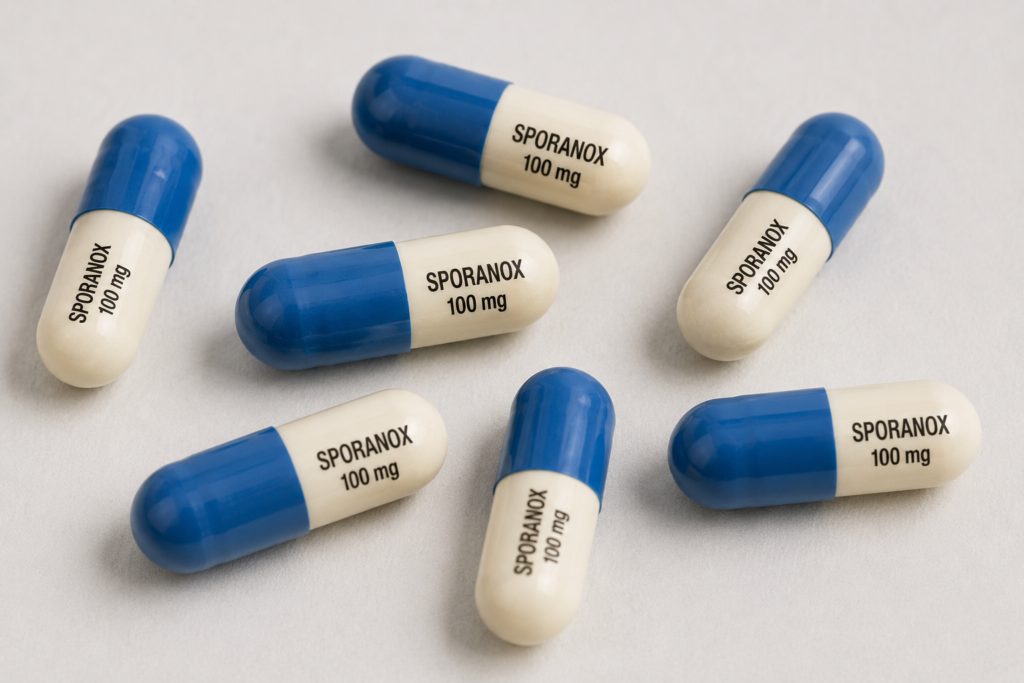
It is sold under the brand name Sporanox, which remains commercially available, and generically as itraconazole.
Get Itraconazole Prescription NowItraconazole
Generic · Sporanox (brand)Who is eligible for an online Itraconazole prescription?
Itraconazole is prescription-only in the U.S. Our telehealth doctors can issue an online prescription for Itraconazole when you meet the following criteria.
You are eligible if
Meet any criteria below
You are not eligible if
Discuss alternatives with a doctor
How much does Itraconazole cost?
Itraconazole is a Tier 3 medication on most insurance formularies, reflecting its specialty antifungal status. Generic capsules are significantly cheaper than the brand. Given that onychomycosis treatment runs 12 weeks or longer, the cumulative cost is worth factoring in.
Consultation Plan — From $20/month
Unlimited consults, refills, and doctor's notes. 24/7 availability.
Cost with insurance
| Plan Type | Generic Itraconazole | Sporanox (brand) |
|---|---|---|
| Medicare Part D | $20 to $50 | $100 and up |
| Medicaid | $0 to $10 | Varies |
| Commercial HMO or PPO | $20 to $60 | $100 to $300 |
| ACA Plans | $20 to $60 | $100 to $300 |
Cost without insurance
- 30-capsule supply at 100 mg (generic): approximately $30 to $80 depending on pharmacy.
- Pulse dosing courses for nail fungus (3 pulse cycles): higher total cost due to repeated monthly fills.
- Walmart, Costco, Kroger: lowest cash prices.
- CVS, Walgreens: higher retail prices.
Tip: GoodRx and similar discount cards can bring the price of generic Itraconazole down meaningfully. Given the length of most antifungal courses, comparing pharmacy prices before filling is worth the few minutes it takes, as prices can vary considerably even within the same area.
Conditions that Itraconazole treats
Our doctors prescribe Itraconazole for the following FDA-approved and clinically established indications.
- Onychomycosis — nail fungus of the toenail and fingernail caused by dermatophytes
- Blastomycosis — pulmonary and extrapulmonary forms
- Histoplasmosis — pulmonary and extrapulmonary forms, including in immunocompromised patients
- Aspergillosis — in patients intolerant of or refractory to Amphotericin B
- Oropharyngeal and esophageal candidiasis — treated with the oral solution formulation
- Sporotrichosis — particularly cutaneous and lymphocutaneous forms
- Tinea corporis, cruris, pedis, and versicolor — in cases requiring oral therapy
Go to an in-person provider or specialist instead
Seek specialist in-person care if you have a severe or invasive systemic fungal infection with signs of rapid progression, significant immune compromise, or organ involvement. These cases require imaging, cultures, and often IV antifungal therapy that cannot be managed through telehealth. Also seek in-person care if you develop signs of liver problems during treatment, including jaundice, dark urine, persistent nausea, or abdominal pain in the upper right side.
Side effects of Itraconazole
Itraconazole carries an FDA black box warning due to the risk of congestive heart failure and serious drug interactions.
These are not theoretical risks. Your doctor will assess your cardiac history and medication list before prescribing.
Common, mild effects
- Nausea, vomiting, or diarrhea
- Abdominal discomfort
- Headache or dizziness
- Fatigue
- Rash
Serious effects covered by FDA black box warning and related warnings
- Congestive heart failure. Itraconazole has negative inotropic properties and has been associated with new or worsening heart failure. Patients with risk factors for cardiac disease require careful assessment before starting treatment.
- Serious drug interactions due to potent CYP3A4 inhibition. Itraconazole dramatically raises plasma levels of many co-administered drugs, which can lead to toxicity. This includes rhabdomyolysis from statins, dangerous sedation from benzodiazepines, and fatal cardiac arrhythmias from certain antiarrhythmics.
- Hepatotoxicity. Liver damage, including fatal cases, has been reported. Risk is highest in patients with pre-existing liver disease or those on prolonged courses.
- Peripheral neuropathy, which may require discontinuation if it occurs.
- Severe skin reactions, including Stevens-Johnson syndrome, in rare cases.
Contraindications and precautions
A safety checklist that your doctor will work through with you before prescribing Itraconazole. Given the FDA black box warning on this medication, these precautions carry more clinical weight than for most common treatments.
- Do not take Itraconazole if you have congestive heart failure or a history of ventricular dysfunction, unless the infection is life-threatening and no alternative exists. This is an FDA black box contraindication.
- Do not take Itraconazole with the following medications, as the combinations are contraindicated: Simvastatin and Lovastatin (rhabdomyolysis risk), Quinidine and Dofetilide (life-threatening arrhythmias), oral Midazolam and Triazolam (extreme sedation), Methadone (cardiac and CNS toxicity), Ergot alkaloids such as Ergotamine and Dihydroergotamine (vasospasm and ischemia), and Cisapride (QT prolongation and arrhythmia).
- Disclose all current medications without exception. Because Itraconazole inhibits CYP3A4 so potently, the number of drugs with clinically significant interactions is large. This includes anticoagulants such as Warfarin, calcium channel blockers, immunosuppressants such as Cyclosporin and Tacrolimus, many HIV medications, and several antiepileptics.
- Do not take Itraconazole if you have active liver disease or significantly elevated liver enzymes. Liver function should be assessed before starting treatment in patients with any history of hepatic problems, and monitored during prolonged courses.
- Do not take Itraconazole if you are pregnant. It is teratogenic in animal studies and is contraindicated in pregnancy for non-life-threatening conditions. Effective contraception is required in women of childbearing age during treatment and for two menstrual cycles after stopping.
- Take capsules with a full meal every time. Absorption is significantly reduced in the fasted state, which can lead to treatment failure, not just reduced efficacy.
- Do not drink alcohol during treatment or for at least three days after completing the course, as the combination stresses the liver and can worsen gastrointestinal side effects.
- Avoid excessive sun exposure during treatment. Itraconazole can increase photosensitivity in some patients.
- Contact your doctor immediately if you develop signs of liver problems during treatment: persistent nausea, loss of appetite, fatigue, dark urine, yellowing of the skin or whites of the eyes, or pain in the upper right abdomen.
- Complete the full prescribed course. Nail fungus in particular requires a complete treatment duration to achieve a cure. Stopping early because the nail looks better does not mean the infection has been eliminated.
Strengths and dosages of Itraconazole
Dosing strategy for Itraconazole depends heavily on the type of infection being treated. Two approaches are used: continuous daily dosing and pulse dosing, where the medication is taken for one week each month with three-week breaks in between.
Capsules
Standard oral form- Onychomycosis, toenail: pulse dosing of 200 mg twice daily for one week per month, for 3 consecutive months. Alternatively, continuous dosing of 200 mg once daily for 12 weeks.
- Onychomycosis, fingernail: pulse dosing of 200 mg twice daily for one week per month, for 2 consecutive months.
- Blastomycosis and histoplasmosis: 200 mg once or twice daily for 6 to 12 months depending on severity.
- Aspergillosis: 200 mg three times daily for 3 days, then 200 mg twice daily.
- Oropharyngeal candidiasis: 200 mg once daily for 1 to 2 weeks.
- Esophageal candidiasis: 100 mg to 200 mg once daily for a minimum of 3 weeks.
Capsules must be taken with a full meal for optimal absorption. Food, particularly fatty food, significantly improves bioavailability of the capsule form.
Oral solution
Alternative formThe oral solution is absorbed differently from the capsule and should be taken on an empty stomach. It is preferred for oropharyngeal and esophageal candidiasis because swishing and swallowing delivers the drug in direct contact with the affected mucosa. Do not substitute capsules for solution or vice versa without consulting your doctor, as the absorption and dosing differ.
Important: Never take Itraconazole capsules on an empty stomach. The oral solution behaves differently and should be taken without food. This distinction matters clinically and affects how much of the drug is actually absorbed.
Meet our online doctors in the United States
Dr. Stotland Mitchell is a board-certified Occupational Medicine physician with 5+ years of experience. He provides virtual care across all U.S. states and D.C., blending allopathic medicine with public health insights. His approach focuses on rapid symptom relief and long-term prevention, often resulting in faster recovery and improved health outcomes for his patients.

Dr. Richard Honaker is a board-certified physician with more than 40 years of experience in family and emergency medicine. He serves as Chief Medical Advisor at Your Doctors Online and is affiliated with Medical City Plano in Texas. Recognized multiple times by D Magazine and Texas Monthly, Dr. Honaker provides evidence-based care across a wide range of conditions including diabetes, hypertension, and injury care.

Dr. Monique Rainford is an OB/GYN expert and Assistant Clinical Professor at Yale School of Medicine. With 25+ years of experience, she’s led OB/GYN departments at Yale Health and Baltimore Medical System. Her clinical interests include pregnancy, menstrual health, chronic pelvic conditions, and lifestyle medicine. Dr. Rainford advocates for maternal health equity, especially in underserved communities.

Dr. Candice Fraser is an OB/GYN practitioner and founder of Trinity Medical Care. With over a decade of experience, she focuses on reproductive care, menstrual health, and menopause management. Along with medical training and residency, she also holds an MBA in healthcare management, blending business insight with clinical excellence.
Dr. Danielle DonDiego is a double board-certified Family and Obesity Medicine physician, business mentor, and author of Self-Care Rx. She focuses on helping patients manage weight, improve nutrition, and adopt sustainable lifestyle changes. A graduate of the Virginia College of Osteopathic Medicine with an MBA from Virginia Tech, she combines her medical expertise with a passion for patient education and long-term wellness.
Dr. Amber Robins is a double board-certified Family and Lifestyle Medicine physician with a strong focus on women’s health, preventive care, and patient advocacy. She earned her MD from the University of Rochester and an MBA from LSU-Shreveport. A published author and media contributor, she blends clinical expertise with a passion for empowering patients to make informed health decisions.
Dr. Nina Carroll is a retired OB/GYN with decades of experience serving women in the U.S. and abroad. She specialized in menopause care, sexual health, and trauma-informed women’s health. Today, she continues her work through medical writing, focusing on sexual minority women’s health and care for survivors of trauma.
Dr. Nerissa Bauer is a behavioral pediatrician specializing in ADHD, parenting strategies, and mental health in children. A former academic and AAP spokesperson, she is the creator of the TEACH Me ADHD program, helping families better understand and manage ADHD. She brings warmth, creativity, and evidence-based guidance to her work with patients and parents.


Frequently Asked Questions
Can you get Itraconazole over the counter in the U.S.?
No. Itraconazole is a prescription-only medication in the United States. It cannot be purchased over the counter at any pharmacy. Given its black box warning and clinically significant interaction profile, this requirement exists to protect patients. A telehealth consultation at Your Doctors Online is the fastest legal route to a prescription, with most patients receiving their prescription sent to a pharmacy within an hour of their consultation.
Is it legal and safe to get an Itraconazole prescription online?
Yes. Itraconazole is not a controlled substance and can be legally prescribed through a properly conducted telehealth evaluation by a licensed U.S. physician. Your Doctors Online is fully HIPAA-compliant. Our doctors follow the clinical guidelines for prescribing azole antifungals, including reviewing the interaction list in full, which is the non-negotiable part of a safe Itraconazole consultation.
Is Sporanox the same as Itraconazole?
Yes. Sporanox is the original brand name for Itraconazole. Both the brand and generic versions contain the same active ingredient at the same approved strengths. Generic Itraconazole 100 mg capsules are the most widely prescribed form and are therapeutically equivalent to Sporanox at a considerably lower cost.
How long does Itraconazole take to work?
It depends entirely on the condition being treated. For oropharyngeal candidiasis, improvement is often noticeable within a few days. For nail fungus, the antifungal works at the nail bed over the course of weeks, but visible improvement in the nail itself takes months because nails grow slowly. Toenails can take 12 to 18 months to fully replace the infected nail with healthy growth, even after the infection has been eliminated. For systemic infections like histoplasmosis or blastomycosis, treatment typically continues for 6 to 12 months depending on severity and immune status.
How long does Itraconazole stay in the system?
Itraconazole has a half-life of approximately 32 to 42 hours in adults, meaning it takes about 7 to 10 days for the drug itself to be substantially cleared from the bloodstream after the last dose. However, the drug and its active metabolite, hydroxy-itraconazole, accumulate in tissues including skin and nails at concentrations significantly higher than plasma. Therapeutic levels in nail tissue can persist for up to 6 months after the last dose, which is why pulse dosing for nail fungus is clinically effective even with weeks between treatment cycles.
Should I take Itraconazole capsules with food or without?
Capsules must be taken with a full meal, preferably one containing fat. Food significantly improves the absorption of the capsule form. Taking capsules on an empty stomach can reduce absorption by more than 50 percent, which means you may not be getting an effective dose even while following the prescribed schedule. The oral solution behaves differently and should be taken on an empty stomach. These are not interchangeable.
Can I drink alcohol while taking Itraconazole?
No. Avoid alcohol throughout the course of treatment and for at least three days after the last dose. The combination increases the burden on the liver, which is already processing Itraconazole, and can worsen nausea and dizziness. Since many Itraconazole courses run for months, this is a meaningful lifestyle consideration worth discussing with your doctor if it is relevant to your situation.
Is Itraconazole or Fluconazole better for yeast infections?
Fluconazole is the preferred treatment for most Candida yeast infections, including vaginal yeast infections, oral thrush, and systemic Candida infections in many settings. It is better tolerated, has a cleaner interaction profile, and is more specifically studied for these indications. Itraconazole has broader antifungal activity across a wider range of fungal species and is preferred for dermatophyte infections, nail fungus, and endemic mycoses like histoplasmosis and blastomycosis where Fluconazole has weaker activity. Your doctor will choose based on the specific organism and infection site.
Which antifungal is stronger than Itraconazole?
For invasive or resistant fungal infections, Voriconazole and Posaconazole have broader activity against some organisms, particularly certain molds and resistant Candida species. Amphotericin B, administered intravenously in hospital settings, is the most potent antifungal available and is used for life-threatening invasive infections. For the dermatophyte and endemic mycosis indications where Itraconazole is commonly used, it is among the most effective oral options available. The question of which is stronger depends entirely on the specific organism and clinical context.
- Create an account
- Share your symptoms
- Talk to an online parasite doctor
- Get a prescription for Mebendazole at your local pharmacy
What are the alternatives to Itraconazole for nail fungus?
For onychomycosis, the main oral alternatives are Terbinafine (Lamisil), which is generally the first-choice treatment for toenail fungus caused by dermatophytes and has a better safety profile than Itraconazole, and Fluconazole, which is used off-label for nail fungus in some patients. Topical treatments such as Efinaconazole (Jublia) and Tavaborole (Kerydin) are available for mild to moderate nail fungus but have lower cure rates than oral agents. Your doctor will recommend the most appropriate option based on the severity of your infection, which nails are affected, and your medical history.
Can Itraconazole be used in children?
Itraconazole is not FDA-approved for use in children for most indications, and pediatric dosing data is limited. It can be used in children in specific clinical circumstances, typically for systemic fungal infections where alternatives are not available or have failed, under specialist supervision. Our telehealth platform is for patients 18 and older.
What should I do if I miss a dose of Itraconazole?
Take the missed dose as soon as you remember, unless it is nearly time for your next scheduled dose, in which case skip it and continue with your regular schedule. Do not double up. For pulse dosing regimens specifically, missing doses within the one-week treatment window can reduce the total drug loading achieved during that cycle. Contact your doctor if you consistently miss doses, as this can affect treatment outcomes for longer courses.
What other antifungal prescriptions are available at Your Doctors Online?
Our doctors can prescribe a range of antifungal treatments depending on the type and location of the infection, including Fluconazole, Terbinafine, Clotrimazole, and others where clinically appropriate.
Get your prescription now
Talk to a licensed doctor about your Itraconazole (Sporanox) prescription