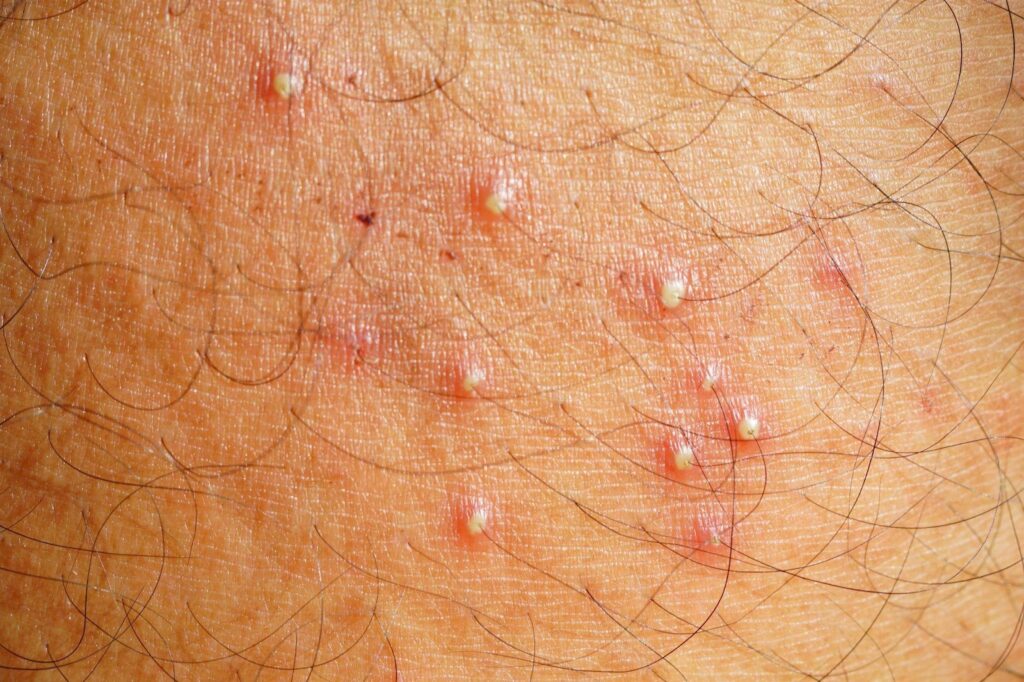
A cluster of small, painful bumps in the groin, buttocks, or inner thigh is one of the most anxiety-inducing things you can find on your body. The two most commonly confused causes are folliculitis and herpes, and working out folliculitis vs herpes correctly is not just an academic exercise, it changes how you’re treated. They can look almost identical on the surface, but they are fundamentally different conditions with different causes, different risks, and treatments that do not overlap. Understanding the difference between folliculitis and herpes starts with knowing what each condition actually is.
Getting this wrong matters. Treating herpes with antibiotics does nothing. Treating bacterial folliculitis with antivirals is equally useless. More importantly, if you have herpes and do not know it, you can pass it to sexual partners even when you have no visible symptoms.
What Is Folliculitis?
Folliculitis is an infection or inflammation of the hair follicle. Each bump forms directly at the base of a hair shaft, which is the key structural feature that separates it from most other skin conditions. According to NIH StatPearls, folliculitis is most commonly caused by bacterial infection, most often Staphylococcus aureus, though fungal species, viruses, and even non-infectious irritation can also trigger it.
Because hair follicles are distributed across nearly the entire body, folliculitis can appear anywhere hair grows: the scalp, face, neck, chest, back, underarms, groin, buttocks, and legs. It is one of the most common skin conditions seen in primary care and dermatology.
What Causes Folliculitis?
Several things can trigger folliculitis, and the cause often determines where it shows up and how it behaves.
Bacterial folliculitis is the most common form. Staphylococcus aureus bacteria infect the superficial hair follicle, producing a pus-filled pustule with a red rim. Common triggers include shaving against the direction of hair growth, tight clothing, friction, and skin trauma.
Hot tub folliculitis is caused by Pseudomonas aeruginosa bacteria in poorly maintained pools or hot tubs. It typically appears on the trunk and areas covered by a bathing suit within 12 to 48 hours of exposure, and usually clears on its own within a week.
Fungal folliculitis (Pityrosporum folliculitis) is caused by Malassezia yeast overgrowth. NIH notes it tends to appear in a cape-like distribution across the shoulders, back, and neck, and is more common in adolescents and young adults due to increased sebaceous gland activity. A key clinical clue: if a breakout is not responding to antibiotics and looks like acne across the upper back, fungal folliculitis should be suspected.
Ingrown hair folliculitis happens when a shaved or waxed hair curls back into the skin. Common sites include the bikini line, beard area, and inner thighs. If you’re trying to rule out an ingrown hair specifically, see our guide on herpes vs ingrown hair for a closer look at that particular mix-up.
What Does Folliculitis Look Like?
Folliculitis bumps are typically small, round, and dome-shaped with a white or yellow pus-filled center. Each bump sits directly at a hair shaft, which you can often see threading through the center of the lesion. The surrounding skin is red and inflamed. The bumps tend to be uniform in size and distributed in a scattered or clustered pattern across the affected area rather than grouped tightly together in one spot.
Folliculitis can itch and be mildly tender when touched, but severe pain is not typical of standard bacterial folliculitis. If the bump looks more like a classic pimple than a fluid-filled blister, our guide on pimples vs herpes covers that specific comparison in more depth.
Let An Online Doctor Tell The Difference
Only an online doctor can tell the difference between folliculitis and herpes
“Connect instantly with an online doctor today to know if it is a skin condition or a lifelong viral infection.”
“You can also connect with a Canadian-licensed online doctor if you are living in Canada.”
What Is Herpes?
Herpes is a viral infection caused by the herpes simplex virus (HSV). There are two strains. HSV-1 primarily causes oral herpes and is responsible for cold sores around the mouth. HSV-2 is almost exclusively sexually transmitted and causes genital herpes. Either type can infect either location through direct contact. However, in rare circumstances, herpes (HSV-1 and HSV-2) can be transmitted from mother to child during delivery, causing neonatal herpes. Symptoms can also present differently depending on who’s affected. For instance, symptoms of herpes in women may present differently.
Herpes is more prevalent than most people realize. According to a 2020 WHO estimate, approximately 520 million people aged 15 to 49 have genital HSV-2 infection globally. As per a WHO update, a figure estimate of 2020, placed the combined genital herpes figure at over 846 million, meaning more than one in five adults in the age group is affected.
For HSV-1, the burden is even higher: an estimated 3.8 billion people, under age 50, as of May 2025, globally carry the virus. The CDC reports that as many as 90 percent of people with genital HSV-2 are unaware they have it, which is what makes the virus so easy to spread.
Unlike folliculitis, herpes cannot be cured. The virus remains dormant in the nervous system and reactivates periodically, producing new outbreaks. Reactivation triggers include stress, illness, hormonal changes, and immune suppression.
What Does Herpes Look Like?
Herpes lesions go through a distinct sequence. Before any visible lesion appears, most people experience a prodrome: tingling, burning, itching, or shooting pain in the affected area. This is the virus reactivating and traveling down the nerve. The prodrome typically lasts one to two days before blisters appear.
The blisters themselves are fluid-filled, often clustered together on a shared red base. They are usually one-sided and confined to a small area. After a few days, the blisters rupture, leaving open, shallow ulcers that are often more painful than the blisters themselves. These ulcers crust over and heal within seven to ten days in a typical recurrent outbreak.
A first-ever primary outbreak is usually more severe and can last two to four weeks, often accompanied by flu-like symptoms including fever, swollen lymph nodes, and body aches.
Folliculitis vs Herpes: Side-by-Side Comparison
The table below breaks down genital herpes and folliculitis across the features doctors check first:
| Feature | Folliculitis | Herpes |
|---|---|---|
| Cause | Bacteria, fungi, ingrown hairs, irritation | Herpes simplex virus (HSV-1 or HSV-2) |
| Lesion type | Pus-filled pustule at the hair shaft | Fluid-filled blister on a shared red base |
| Lesion shape | Round, dome-shaped, uniform | Variable shape, clustered together |
| Pain level | Mild tenderness when touched | Often painful, especially during the ulcer stage |
| Prodrome (warning signs) | None | Tingling, burning, or shooting pain before blisters appear |
| Systemic symptoms | None | Fever, swollen lymph nodes, body aches in primary outbreak |
| Location pattern | Anywhere hair grows, scattered | Typically one-sided, localized to one area |
| Contagious | Minimally (sharing razors, towels) | Highly contagious, including no visible sores |
| Recurrence | It can recur if the underlying trigger persists, but not in the same spot on a set schedule | Recurs periodically for life |
| Resolution | Clears in 7 to 14 days with treatment | Outbreaks resolve in 7 to 10 days, but the virus stays |
| Treatment | Antibiotics, antifungals, or home care | Antiviral medications (acyclovir, valacyclovir) |
The 5 Key Differences That Doctors Look For
1. Whether there was a prodrome
Folliculitis does not come with warning signs. Bumps appear, often after a recent shave or hot tub, without any preceding tingling or burning. Herpes almost always announces itself. The tingling or shooting nerve pain that occurs one to two days before blisters appear is a strong clinical signal. If you noticed burning or itching in the skin before any visible lesion appeared, herpes is more likely than folliculitis.
2. Lesion location relative to hair shafts
This is the most reliable visual clue. Every folliculitis lesion is anchored to a hair follicle, meaning you should be able to see a hair thread through or beside the bump. Herpes blisters do not follow hair follicles. They can appear on any skin surface in the affected area, including skin without hair. If bumps are appearing on areas where hair is sparse or absent, folliculitis is less likely. This is especially useful when working out pubic folliculitis and herpes, checking whether the bump sits directly on a hair follicle or on smooth, hairless skin.
3. Whether bumps are one-sided or scattered
Herpes typically presents unilaterally, accurately for shingles (Herpes Zoster) because it strictly follows a single nerve dermatome. However, genital herpes (HSV-1 or HSV-2) routinely presents bilaterally (on both sides of the groin or buttocks) during a primary outbreak. While recurrent outbreaks can be one-sided it is less of a hard-and-fast rule for HSV than for shingles.
Folliculitis usually scatters more randomly across an area because it follows hair follicle distribution rather than nerve pathways. When comparing groin folliculitis or herpes specifically, scattered pustules spread across the groin point toward folliculitis, while blisters clustered tightly in one patch point toward herpes.
4. Systemic symptoms during a first outbreak
A primary herpes outbreak can feel like the flu. Fever, fatigue, swollen lymph nodes in the groin (for genital herpes) or neck (for oral herpes), and muscle aches are common with a first-ever HSV infection. Folliculitis produces no systemic symptoms at all. If you are dealing with skin bumps and you also feel ill, herpes warrants serious consideration.
5. Recurrence pattern
Folliculitis, once treated and the trigger removed, does not keep coming back in the same spot on a predictable schedule. Herpes recurs in the same location or general area repeatedly over months and years. If you have a second or third episode of painful blisters appearing in the exact same area, herpes is far more likely than folliculitis.
Can Herpes Cause Folliculitis?
Yes. Herpetic folliculitis, sometimes called herpes folliculitis or herpes simplex folliculitis, is a real, if less common, condition that occurs when the herpes simplex virus infects hair follicles directly. The result is a presentation that genuinely combines features of both conditions in the herpes and folliculitis overlap: the lesions arise at hair follicle sites (like folliculitis), but they contain viral material and produce the tingling prodrome and ulceration characteristic of herpes.
Herpetic folliculitis is most commonly seen in the beard area (known as sycosis barbae or herpetic sycosis), where it can be triggered or spread by shaving. It requires antiviral treatment, not antibiotics, which is why correct diagnosis matters even when the location looks like folliculitis.
How Each Condition Is Diagnosed
Searching folliculitis or herpes pictures online can give you a general sense of what each looks like, but photos alone are not a reliable way to self-diagnose, lighting, skin tone, and the stage of the outbreak all change how a lesion appears. A doctor examining you directly, or reviewing a clear photo alongside your symptoms, is far more accurate than comparing your skin to pictures found online.
Diagnosing Folliculitis
For straightforward bacterial folliculitis, diagnosis is usually clinical. Your doctor examines the lesions, asks about recent shaving, hot tub exposure, antibiotic use, and clothing friction, and makes the call visually. A bacterial culture of the pus may be taken in cases that are severe, recurrent, or unresponsive to first-line treatment. This identifies the specific organism and its antibiotic sensitivity, which guides treatment adjustments.
For suspected fungal folliculitis, a KOH preparation or fungal culture can confirm Malassezia overgrowth.
Diagnosing Herpes
Herpes diagnosis requires laboratory confirmation, not visual examination alone. The clinical standard is a PCR swab of an active lesion. PCR is the most sensitive and specific method available, detecting viral DNA directly from the lesion fluid. Testing is most accurate when performed on an active blister before it has ruptured and crusted over. A swab of a healing ulcer or a crusted lesion significantly reduces sensitivity.
Blood-based HSV type-specific serology (IgG antibody testing) can confirm past infection even when no active lesion is present, but it cannot determine when the infection was acquired or whether a current lesion is caused by HSV.
Do not wait for sores to heal before seeking testing. Once lesions crust over, viral load in the lesion drops sharply, and swab accuracy decreases.
Treatment: Folliculitis vs Herpes
Treating folliculitis
Most mild bacterial folliculitis resolves without prescription treatment. Doctors often recommend warm, moist compresses, applied several times a day, gentle cleansing with antibacterial soap, and over-the-counter antibiotic ointments such as mupirocin, a prescription med in both the US and Canada, or bacitracin for early-stage infections.
For more persistent or widespread bacterial folliculitis, an oral antibiotic is appropriate. Common first-line choices include dicloxacillin, cephalexin, or trimethoprim-sulfamethoxazole, depending on the suspected organism and local resistance patterns.
Fungal folliculitis does not respond to antibiotics and requires antifungal treatment: topical ketoconazole or selenium sulfide shampoo for mild cases, and oral fluconazole or itraconazole for more extensive involvement.
Hot tub folliculitis typically resolves on its own within seven to ten days. Avoiding the contaminated water source prevents recurrence.
Treating herpes
Herpes has no cure. Antiviral medications manage outbreaks and reduce transmission risk but do not eliminate the virus. The CDC STI Treatment Guidelines identify three FDA-approved antivirals as first-line options: acyclovir, valacyclovir, and famciclovir. Valacyclovir is the preferred option for most patients due to better oral absorption and less frequent dosing compared to acyclovir. Episodic treatment of recurrent herpes is most effective if therapy is initiated within 1 day of lesion onset or during the prodrome that precedes some outbreaks.
Antivirals are most effective when started early. Starting treatment within 1 day of lesion onset or during the prodrome. For people with frequent recurrences (six or more per year), daily suppressive therapy significantly reduces both the frequency of outbreaks and the risk of transmitting the virus to a partner. A clinical trial published in the Infectious Diseases in Obstetrics and Gynecology found that daily valacyclovir reduced HSV-2 shedding by 78 percent compared to placebo. A rough estimate of 70-80% reduction in various research.
Topical antiviral creams provide minimal benefit for genital herpes and are not recommended as primary treatment by current guidelines.
When You Need to See a Doctor
Some presentations require in-person evaluation or same-day care rather than a telehealth consultation.
Go to a clinic or urgent care if you have:
- Rapidly spreading redness, warmth, and swelling around a folliculitis lesion, which can indicate cellulitis, a deeper skin infection
- A large, painful, fluctuant mass that may be a furuncle (boil) or carbuncle requiring drainage
- Fever alongside a skin infection
- A first-ever outbreak with severe genital ulceration and systemic symptoms, as primary herpes can occasionally cause urinary retention and require additional intervention
- Any unusual skin lesion in a newborn or infant, as neonatal herpes is a medical emergency
For recurrent outbreaks, routine refills, or straightforward folliculitis that is not improving, an online consultation is appropriate and faster. If you’re still unsure whether it’s folliculitis or herpes, an online doctor can review your symptoms and photos to help you decide next steps.
Frequently Asked Questions
Yes, and that is exactly why misdiagnosis is common. Both conditions can produce painful, fluid-filled bumps in the groin, buttocks, or thigh. The key differences are that folliculitis lesions are anchored to visible hair shafts, do not come with a tingling prodrome, and do not recur in the same spot on a predictable schedule. If you are unsure, a PCR swab during an active lesion is the only way to rule herpes in or out definitively.
Yes. They are not mutually exclusive. You can have a herpes outbreak in one area and bacterial folliculitis in another simultaneously. Herpetic folliculitis is also a real condition where HSV directly infects the hair follicle, combining features of both. This is another reason clinical examination alone is not always sufficient for diagnosis.
Mild bacterial folliculitis often clears within one to two weeks with good hygiene, warm compresses, and avoiding the trigger. Hot tub folliculitis typically resolves without treatment. Fungal folliculitis and recurrent folliculitis usually require prescription treatment to clear fully.
A first-ever primary herpes outbreak typically lasts two to four weeks and tends to be the most severe outbreak a person will have. Subsequent recurrences usually resolve in seven to ten days. Antiviral therapy started within 1 day of lesion onset or during the prodrome shortens the duration and reduces severity.
Yes. Herpes transmits through a process called asymptomatic viral shedding, where the virus is present on the skin surface without any visible lesion. This is how most transmission occurs, since most people with herpes do not know they have it. Daily suppressive antiviral therapy reduces, but does not eliminate, the risk of transmission.
Standard bacterial folliculitis is not considered a sexually transmitted infection, but the bacteria can transfer through shared razors, towels, or direct skin contact with an active lesion. Fungal folliculitis is not transmitted through physical contact. Neither form of folliculitis creates the ongoing transmission risk that herpes does.
Yes. The risk of assuming it is folliculitis when it is actually herpes is significant. You could unknowingly transmit the virus to a partner. Testing during an active outbreak is straightforward and takes a single swab. An online doctor can order testing and walk you through the results.